Our school acknowledges the Traditional Custodians of this country, the Noonuccal, Goenpul and Ngugi peoples and pays respect to our Elders past, present and future.
First Nations Education
Doing well at school improves a range of life outcomes for students, their families and their communities. This includes physical, social, emotional, cultural and spiritual wellbeing, including employment and income. We want every Aboriginal and Torres Strait Islander student empowered to realise their full potential.
We're committed to walking alongside First Nations students and families on their educational journey. This includes our interactions and partnerships with Elders, community, government and organisations.
We're committed to teaching all students about our shared history. A deeper understanding and respect for First Nations cultures strengthens all Australians' appreciation of the living cultures of Australia and supports meaningful reconciliation.
Student Engagement
Our school offers a range of programs to provide cultural safety, build strength of identity, and support and extend the engagement and achievement of First Nations students:
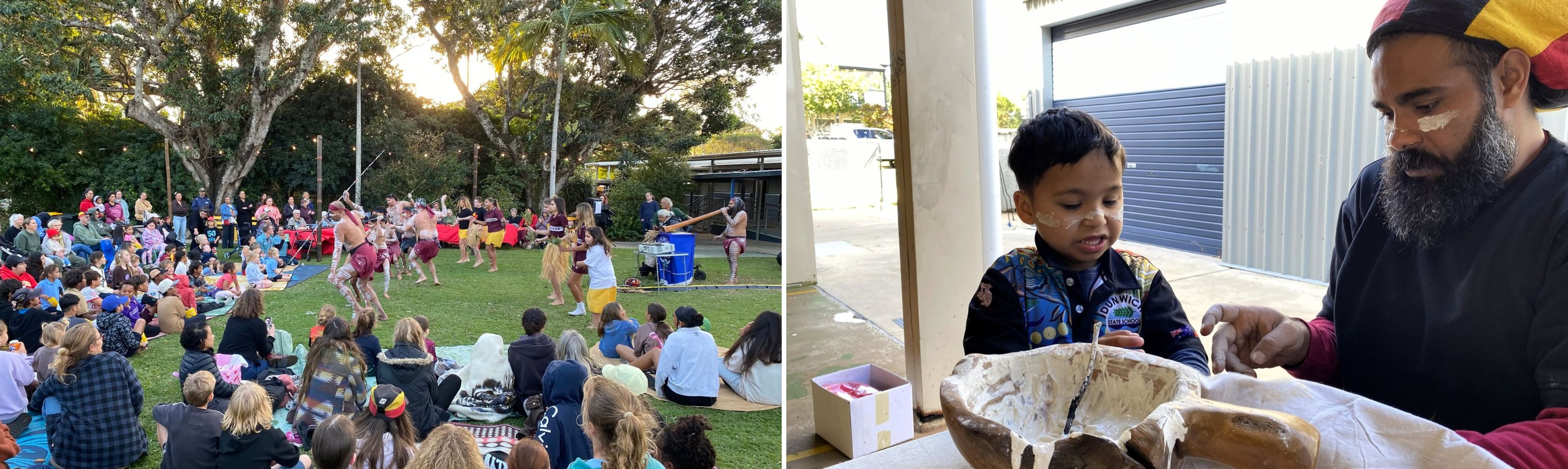
- Cultural Studies lessons for all students each week - learning about history, environment, art, food, language and dance, and engaging in 'On-Country' cultural learning experiences on Minjerribah (North Stradbroke Island)
- Yarning Circle - for Elder talks and for class lessons
- Whole-school cultural celebrations and recognitions: NAIDOC Week celebrations, Reconciliation Week activities, National Sorry Day commemoration
- ‘Deadly Room’ as a culturally safe wellbeing space
- Student and family support by a First Nations Community Education Counsellor (CEC)
- Deadly Choices - healthy lifestyle program
- First Nations perspectives and local cultural knowledge integrated into the curriculum for all year levels
- Cultural Leader positions for our Year 6 Jarjums
- Quandamooka Jarjums Camp coordinated by Dunwich State School (for all year 6 DSS students, along with year 6 jarjums attending a state primary school on Quandamooka country) - for cultural knowledge and to support student tranisiton to high school
Community Partnerships
Dunwich State School works closely with a range of organisations and services to support improved outcomes for First Nations students and families:
- Minjerribah Moorgumpin Elders in Council (MMEIC) - for cultural knowledge and leadership, to build the cultural capacity of staff, and collaborating to deliver programs like student talks and NAIDOC workshops
- Yulu-Burri-Ba - for student health checks and therapy services
- Cleveland District State High School - to share and align school-based support services and to support student transitions
Our School Community Partnership Facilitator establishes and sustains community partnerships, and oversees major partnership programs:
- collaborating directly with school principals to address unique local needs and performance goals
- working closely with local and regional agencies to support improved educational outcomes, attendance, and cultural wellbeing for First Nations students
- coordinating links with organisations and services to strengthen school-community ties
Local Community Education Body (LCEB)
The Local Community Education Body (LCEB) aims to embed First Nations community voices in school priorities and decisions, to improve educational outcomes, attendance, and cultural wellbeing for Aboriginal and Torres Strait Islander students.
The LCEB meets twice per term to establish and enact an improvement focus that complements both the commitments from the principal and the school's strategic plan. The LCEB consists of 10 members nominated and elected from community and endorsed through a collaboratively scrutinised process of both Department of Education (DoE) representatives and the Minjerribah Moorgumpin Elders in Council (MMEIC):
- Clinton Beutel (co-chair) – Principal: Dunwich SS
- Pekeri Ruska (co-chair) – MMEIC Justice Reinvestment team, DSS parent
- Natalie Mazzoni (co-chair) – DSS parent
- Mahala Burns – DSS parent
- Brian Coghill – MMEIC Director
- Kiesha Coghill – Stradbroke Early Learning Centre manager, DSS parent
- Narelle Fisher – DSS parent
- Tia Kaden – Yulu-Burri-Ba
- Kiana Piazetta-Charlton - Director of The Centre for First Nations Education and Wellbeing at Cleveland District state High School
- Ben Mos – Moreton Bay Research Station: University of QLD
- Chelsea Rolfe – MMEIC Justice Reinvestment team, DSS parent
- Chris Day – Manager: Department of Education (Metropolitan South) Aboriginal and Torres Strait Islander Team (Partnerships & Programs)
- Sonya Stevens – Guidance Officer: Dunwich SS
- Rachel Stone – School-Community Partnerships Facilitator: Dunwich SS